Tuesday, August 9, 2011

What to say to your city councilperson

Tell your city councilperson facts why livable streets matter to you.
Every single time I meet with or e-mail my City Council person it is about a biking and walking issue. Generally, I want him to get us more infrastructure that allows me, my wife and our neighbors to safely use active transportation where we live. My councilman wouldn't know what to think if I came to him to talk about anything unrelated to livable streets. Maybe I'll surprise him sometime...

You may or may not be like me. How often do you communicate your wishes for traffic calming, healthy neighborhoods and transit connections to your local elected officials? (Maybe I ought to back up a step and ask if you know who your city councilperson even is? When are his or her office hours?) When you talk to your councilperson are you representing yourself or are you part of something bigger? I don't mean the human race here rather are you part of a local bicycle-pedestrian advocacy group, senior center or PTA/PTO.

If you go it alone when you talk to your councilperson do you have data to back you up? If you are part of a larger group do you have a common message? Missouri Livable Streets has developed a set of livable streets talking points. Check them out and see what resonates with you. By the way, the research to support each talking point can be found starting on page 41 of our full Livable Streets Advocacy Guide.

Why use talking points when advocating for more livable streets? If you are advocating for more traffic safety for pedestrians in your neighborhood it is great to be able to say that 51% of the American population walks at some point in the year. How about backing up your request for sidewalk extensions by dropping the fact that more than 15% of walkers walk more than 2 miles. Sadly, almost 5,000 Americans died while walking in 2009. This kind of data makes your case for livable streets all the more powerful.

Talking about funding makes a powerful statement, too. Many local governments in Missouri and elsewhere are in a tight financial spot right now. After you make the case for more sidewalks or bicycle paths or transit connections in your community you can show your elected official the money by downloading and printing a copy of our livable streets funding sources.

Thanks for reading. See you in the streets, Trevor


Tuesday, August 2, 2011

Livable streets connect to transit

Yesterday, I got educated when I expected to give some education.

The Missouri Public Transit Association is the statewide group for transit operators. They meet annually at a conference center. This year they were generous enough to let me organize and facilitate a conference panel about how transit needs livable streets. The panel was me, the PedNet Coalition's Sam Robinson, Citizens for Modern Transit's Seth Teel and Larry Magill.

You'll notice that Larry doesn't have an association. He told me when I introduced him that we could be there as the Chair of the Camden County Senior Tax Board. That doesn't really say who he is though.

Larry is a 60-something crusader on wheels. He wowed me and the others in the room with tales of this ongoing efforts to make his adopted Ozark hometown more accessible for seniors and those in wheelchairs. Larry uses a wheelchair as a result of mobility issues related to a childhood case of polio. He talked about how transit has come a long way from his days having to be lifted onto and off of his bus. This was when he went to the Crippled School in Kansas City. That's what it was called.

Larry reminded us that years after the Americans with Disabilities Act was signed into law there is still much to be done to make public and retail spaces universally accessible. We saw pictures of Larry navigating various doors, ramps, curbs and transit vehicles within the Lake of the Ozarks region. I must say: when the information comes at you from someone who is impacted most by livable streets it hits home. Without a sidewalk or a curb Larry can't get into that building.

As livable streets advocates we need to get better at telling our stories. We need to talk to our city councils and be honest about why we need better sidewalks, bicycle facilities and access for all. These elected folks are the ones who officially decide when and where and how a street gets build. They have the power to make local streets more livable. Stories from the likes of Larry Magill and from the rest of us can have significant and sometimes rapid impact on how walkable, bikable and livable our streets are.

Thursday, July 28, 2011

Networking to spread the Livable Streets message

The Livable Streets Team is out in force today at the quarterly meeting of the Missouri Council for Activity and Nutrition.

MOCAN is a statewide coalition of state and agencies, academics, public health practitioners and other like-minds who met quarterly to explore how to create a healthier and more active Missouri. Missouri Livable Streets is a sponsored program of MOCAN.

I am grateful for the networking opportunities that happen when I go to MOCAN meetings. Today at MOCAN I learned how public health nurses in Southeast Missouri are working to make kids more active. There is a livable streets part to that puzzle. I also learned about Livable Streets efforts happening in Johnson County, Kansas (in Metro Kansas City). There were other tales of community members warming (literally this month!) to the idea of livable streets in their towns.

By participating in coalitions such as MOCAN Missouri Livable Streets gets to spread the message to corners of the state that our small staff and advisors could not reach by ourselves. If you are interested in spreading the message about livable streets to a local group you work with check out the information we have for advocates like yourself at our website.

Be well and see you in the streets,
Trevor

Tuesday, July 19, 2011

Building on Missouri's Great Places

Missouri has a lot of wonderful communities. Whether they hug the Missouri River, rest amongst Ozark hills or serve as regional trading hubs in the farm country of the north.


Imagine these cities, towns and rural places building on their current greatness by becoming more intentionally more walkable, bikable and accessible for those in wheelchairs. Imagine these places with density and forms that encourage residents to be active in reaching destinations that we all care about: the grocery store, the parks, friends houses and church. To build on their current greatness, Missouri's cities need to consider how all residents move throughout town. When local leaders only consider how to move cars as fast as possible we end up with communities sold out to concrete, oil and speed. Yes, Missourians who have them are dependent on their cars to get to work, school and retail.

In an effort to get our cities thinking more about how to create communities that are friendlier for those on foot, bike and wheel the Missouri General Assembly adopted on May 12 a Complete Streets Resolution. This resolution encourages communities to consider and adopt local Complete Streets policies. Such policies require "organizations and agencies that build, control, maintain, or fund roads, highways, and bridges in Missouri to adopt Complete Streets policies and to plan, design, build, and maintain their road and street system to provide complete, safe access to all road users." Local complete streets policies are one step to getting more walkable, bikable and accessible communities. Additional steps might include revising local zoning ordinances to see how these encourage the construction of quality places that encourage active transportation and social interaction. The Mid-America Regional Council is heading the right direction by encouraging local governments to support pedestrian activity centers among its member governments in the Kansas City metro area.

Friday, July 8, 2011

A reminder about the economy of livable streets

Here is a reminder from one bicycle commuter that not all who ride and walk do so as a choice. Some need to walk and ride and use transit as a matter of economics.

At Missouri Livable Streets we work to create change and provide information that is accessible to all citizens regardless of their abilities or means. Sometimes, however, we tend to run with people just like us. We need reminders that there remain great numbers of Americans who simply will not come to advocacy trainings, get organized and advocate for change at the times and places we tell them to. Such invisibility clearly is not due to apathy so much as these folks are busy working (maybe a couple jobs), raising families and trying to keep it together financially.

Elly, thanks for the reminder. We can and will try harder to remember those who truly need livable streets.

Monday, June 27, 2011

Livable Streets Advocacy Trainings Planned

Save a date for livable streets! Our second series of Livable Streets Advocacy Trainings are coming soon to several Missouri communities. These are trainings for citizens who want to become more effective advocates for bicycle-pedestrian infrastructure in their communities. Trainings are free, fun and we feed you!


The next round of Missouri Livable Streets Advocacy Trainings are on tap for:
  • August 27 in St. Louis County
  • August 30 in Raytown
  • September 13 in O'Fallon

More information soon at this site and at LivableStreets.missouri.edu!

Saturday, June 18, 2011

Livable Streets: Mid-Missouri Swing

I went into the Livable Streets presentation to the economic developers somewhat concerned. I was prepared mind you. I had my presentation down. I was  ready to lay on them the research I found stating that when communities build streets that consider the needs of all users property values increase, retail sales rise and tourism follows. My concern was that I would get pounced on during the Q&A. Would these folks at their annual meeting at the Lake of the Ozarks complain that forcing developers to build sidewalks would drive new jobs away? If that came my way I was ready to take a deep breath and explain that besides jobs quality development includes a sustained quality of life. Walkable, bikable and accessible communities are part of that mix.

But those questions didn't come.

One woman - reacting to a picture I showed of a golf cart on a small town street - asked if the Missouri Department of Transportation shouldn't reconsider their position of not allowing carts on their roads. Not exactly the rigorous debate I expected.

After my presentation most of the 150 or so economic developers ran out to lunch or to send a few texts. Several remained however eager to talk to me about the opportunities they saw in their communities for rail-to-trail conversions and how to build a local constituency around active transportation. When I had earlier asked for a show of hands a minority said they saw livable streets as a local asset that needs to be included in how they market their places when attracting businesses and retaining investors and residents. My goal was to convert their thinking on that and leave with a roomful of converts. When you next see your local economic developer ask him or her whether they are supportive of livable streets.

I spent the second half of Thursday meeting with allies in Jefferson City and Sedalia. Missouri Livable Streets in partnership with Columbia's PedNet Coalition will offer Livable Streets Advocacy Trainings in these two communities later this summer. In both cases there are already local groups meeting and addressing the issue of how to make neighborhoods and commercial corridors more supportive of bicycling, walking and accessible for those who rely on sidewalks, curb cuts and transit access to get around town.

Communities are ready for livable streets. Missourians hate traffic. By and large we don't think of ourselves as an urban place where we grind around in traffic. (Urban Missourians have different challenges. More on that next week.) I am pleased to report there are bike-ped advocates, public health leaders, downtown directors, elected officials and citizens who are working in smaller towns like Sedalia, Chillicothe, Vinita Park, Albany and a bunch of other places. They are creating healthier built environments for those who can't drive or who choose not to drive.

Here's some images from my visit to Sedalia taken after I met Thursday evening with the Citizens Committee on Smart Growth. That committee is the likely host for a July Livable Streets training in their city.

Pedestrians must find Downtown Sedalia very walkable...

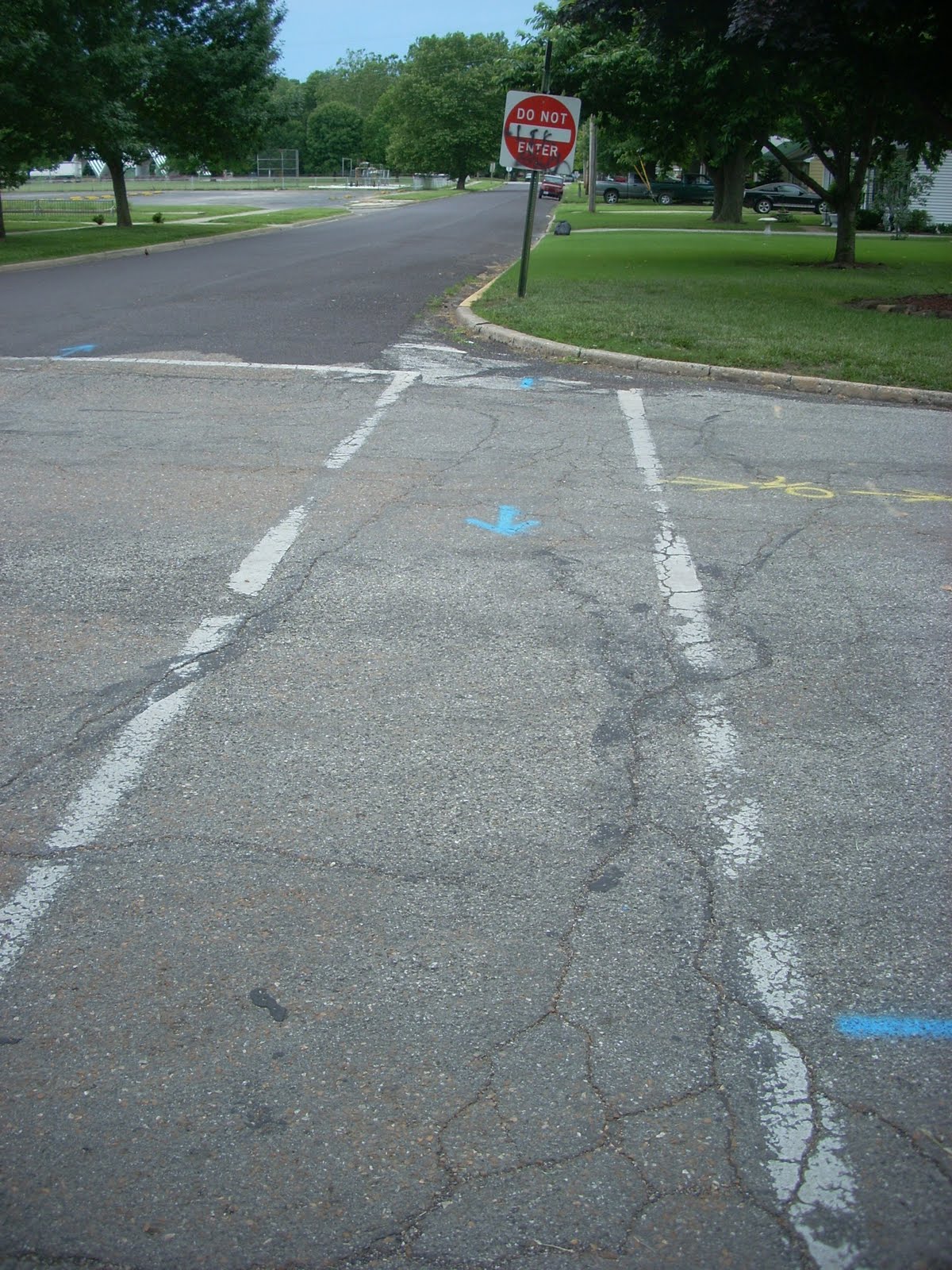
...but faded crosswalks with no curb cuts greet students on their walk to a Sedalia primary school.

Do you see the sidewalk in front of your house as an amenity?

Walking to the bar is always a better choice than driving.

Great new crosswalks and curb cuts along Sedalia's Ohio Street are welcoming.
Looking south down Sedalia's Ohio Street remains one of my favorite scenes in Missouri.